
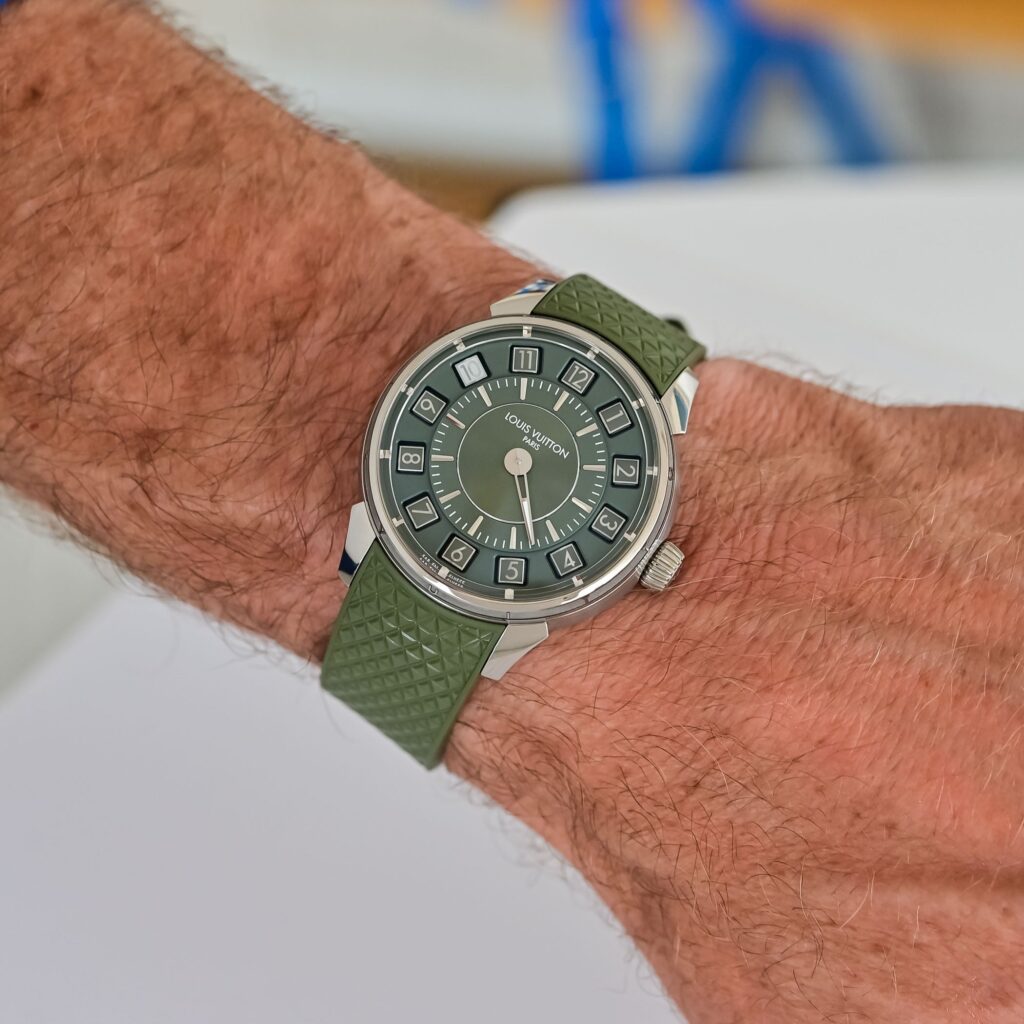
Louis Vuitton has expanded the Tambour Spin Time collection with five new references that join the permanent catalogue, moving the twelve-cube jump-hour complication from limited production into serial availability. The watches retain the architecture introduced in 2025 under the Tambour Taiko name but replace the restrained dolphin-gray palette with green, blue, Australian opal, salmon, and platinum executions. For manufacturing partners and in-house ateliers alike, the transition from numbered editions to permanent stock represents a significant recalibration of dial-finishing workflows and module-assembly capacity.
The Spin Time mechanism, developed by Michel Navas and Enrico Barbasini, uses twelve rotating cubes encircling the dial to indicate the hour. Each cube makes a 180-degree rotation on the full hour, with the light side marking the current time. The concept takes its inspiration from mechanical departure boards once found in airports and railway stations. The 2025 Tambour Taiko collection established four configurations—the 39.5mm Spin Time, the 42.5mm Spin Time Air, the Antipode world timer, and the Flying Tourbillon—across limited runs of 50 to 150 pieces depending on complexity. The new collection uses the same case dimensions and movement architecture but removes the production caps entirely.
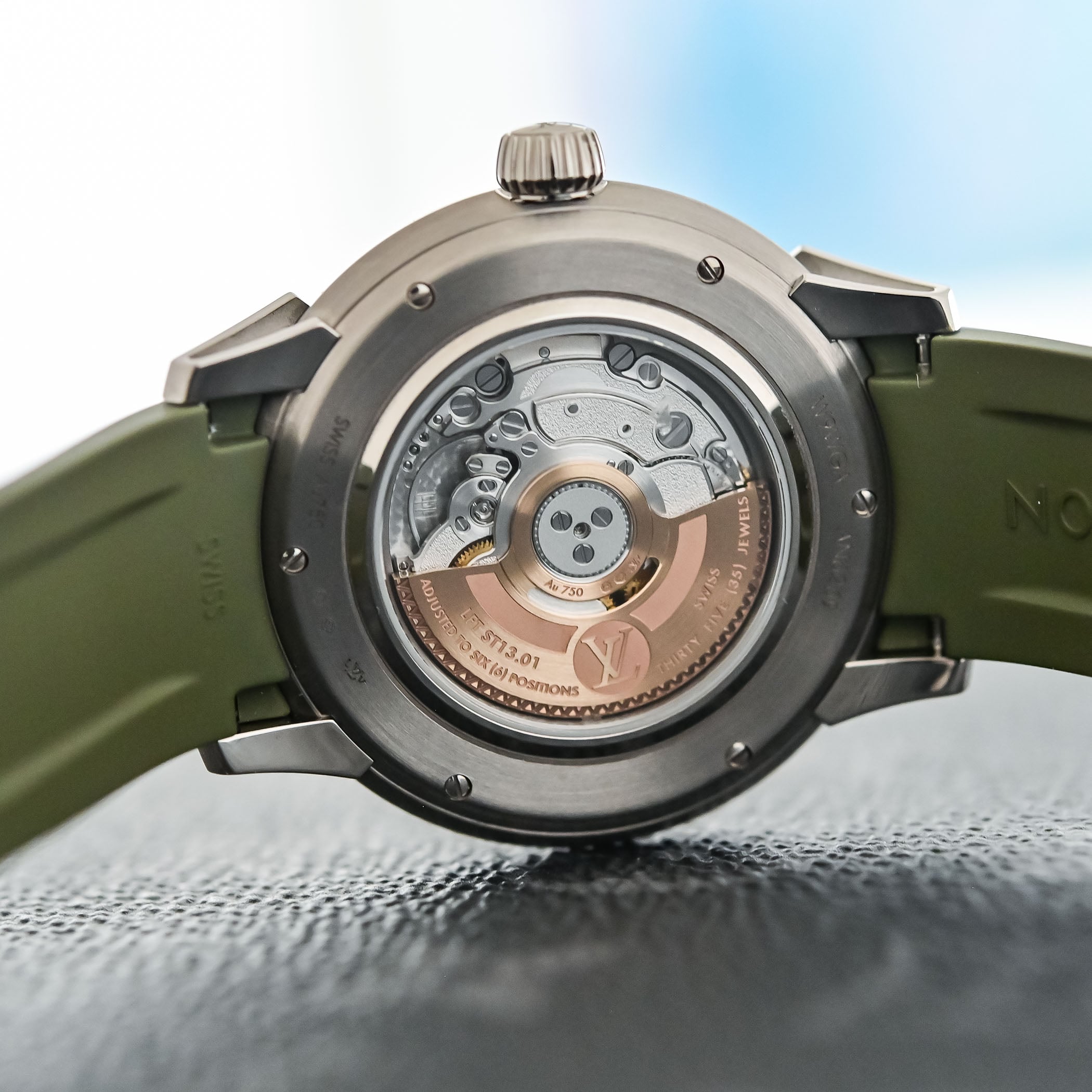
Three automatic calibres power the five references. The LFT ST13.01 drives both the 39.5mm Spin Time and the 42.5mm Spin Time Air, containing 246 components and 35 jewels. The Antipode world timer uses the LFT ST12.01, which houses 271 components and 36 jewels. The Flying Tourbillon relies on the LFT ST05.01, with 283 components and 40 jewels. All three movements run at 28,800 vibrations per hour and deliver a 45-hour power reserve. Louis Vuitton states that the LFT ST05.01 requires approximately 50 hours to assemble, making it substantially more labor-intensive than the other calibres, while the platinum case for the Flying Tourbillon takes roughly twice as long to complete as the corresponding gold cases.
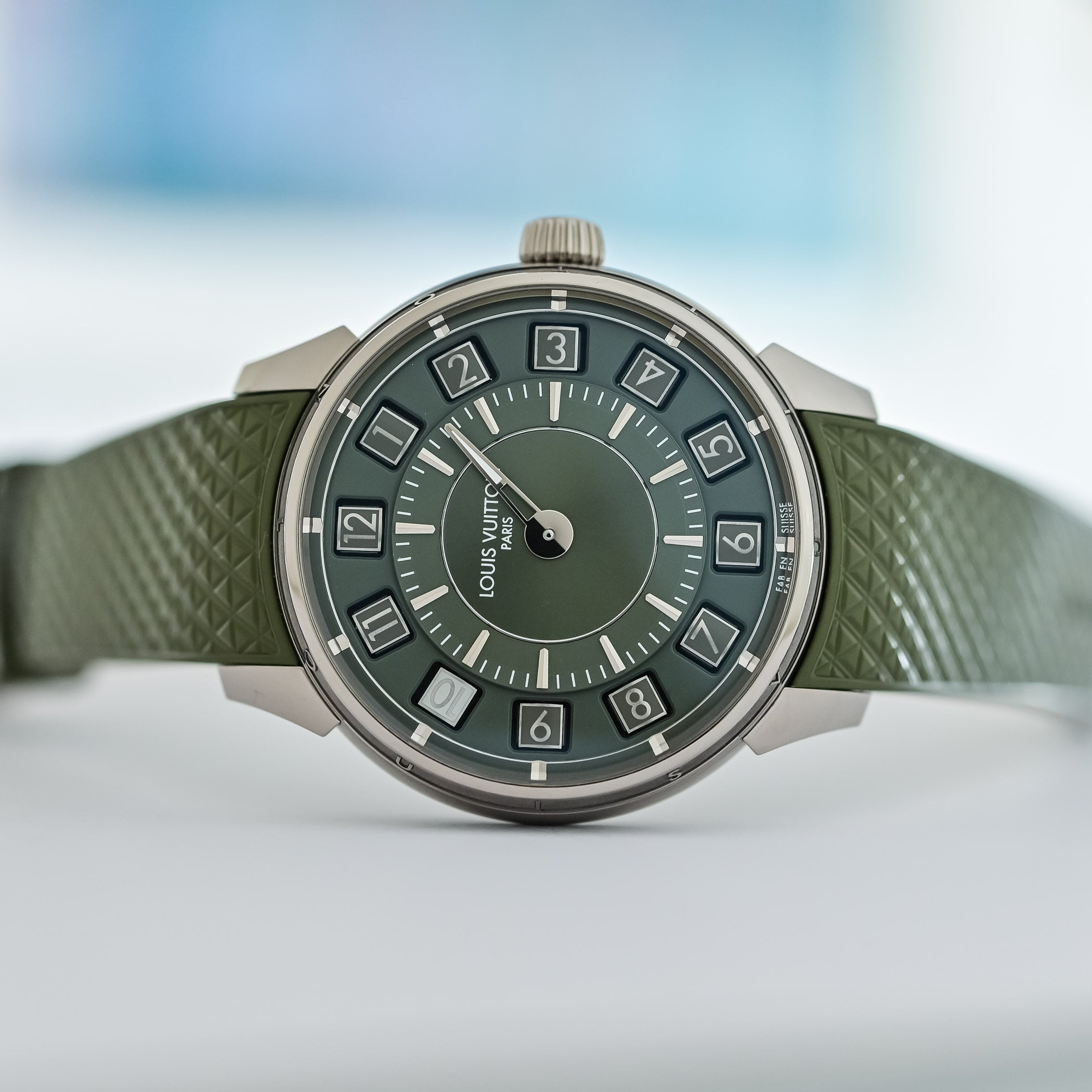
The simplest execution is the 39.5mm Tambour Spin Time in white gold with a deep green dial. The dial combines sandblasted and satin-finished surfaces, with twelve numbered cubes surrounding the central minutes display. The case measures 12.15mm in profile and carries a 100-meter water resistance rating. A sapphire case back reveals the LFT ST13.01, finished with micro-sandblasted bridges, polished chamfers, transparent jewels, and an 18K rose gold winding mass. The watch is worn on a matching green rubber strap.
A second 39.5mm reference uses an 18K rose gold case and a dial made from blue Australian opal, with the stone also appearing between the twelve rotating cubes. The bezel and lugs are set with baguette-cut blue sapphires, while the hour markers contain baguette-cut diamonds. In total, the watch uses 82 blue sapphires and 12 diamonds, totaling approximately 4.71 carats. The movement remains the LFT ST13.01, paired with a blue rubber strap.
The 42.5mm Spin Time Air returns in a permanent blue version. The open architecture removes the material between the cubes, creating the floating appearance that gives the model its name. The cubes feature alternating blue and white backgrounds, while their polished studs reference the rivets used on Louis Vuitton trunks. The white gold case measures 12.45mm thick and offers 50 meters of water resistance. A matching blue calfskin strap completes the watch.
The Antipode carries over the most unusual complication from the 2025 collection. Rather than showing twelve time zones, it uses the twelve cubes to display 24 cities, pairing locations that are twelve hours apart. Los Angeles and Dubai, New York and Bangkok, and other city pairs share individual cubes. The contrasting sides of each cube indicate day and night, while a small yellow pointer shows local time. The 42.5mm white gold case retains the 12.45mm thickness and 50-meter water resistance of the Spin Time Air.
The most complicated reference is the Spin Time Air Flying Tourbillon. Its 42.5mm platinum case houses a central flying tourbillon alongside the rotating-hour display. The salmon-colored dial provides the biggest visual departure from the gray Flying Tourbillon presented in 2025. The tourbillon cage retains its Monogram flower shape, and the watch is worn on a matching salmon rubber strap.
The shift from limited editions to permanent availability changes the production calculus for any complication that involves modular dial construction. A run of 150 pieces can be managed as a batch campaign, with dedicated tooling setups and finishing schedules that begin and end within a defined window. Permanent production requires a different approach: steady throughput, repeatable quality control, and the ability to scale assembly capacity without compromising the hand-finishing that defines the product. For the Spin Time, that means maintaining consistent tolerances across the twelve rotating cubes, ensuring smooth actuation of the jump mechanism, and coordinating dial finishes—sandblasted, satin, opal inlay, gem-setting—across multiple references that share the same movement platform but diverge sharply in surface treatment. Fashion houses building or refreshing collections with manufacturing partners will recognize the challenge: moving a signature complication from limited spectacle to serial production demands not only technical repeatability but also a supply chain capable of supporting open-ended demand for specialized components and finishes.